
Last updated November 22, 2026
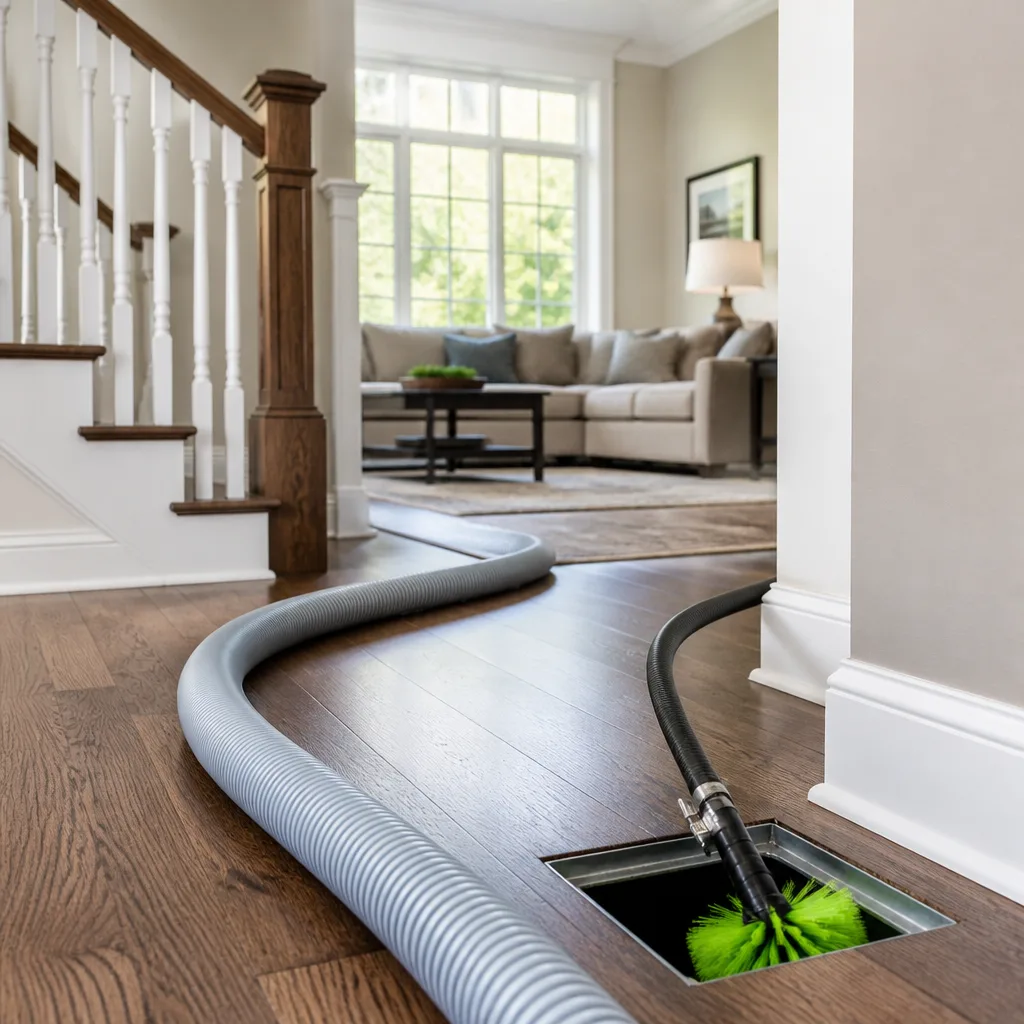 Whole-home duct cleaning
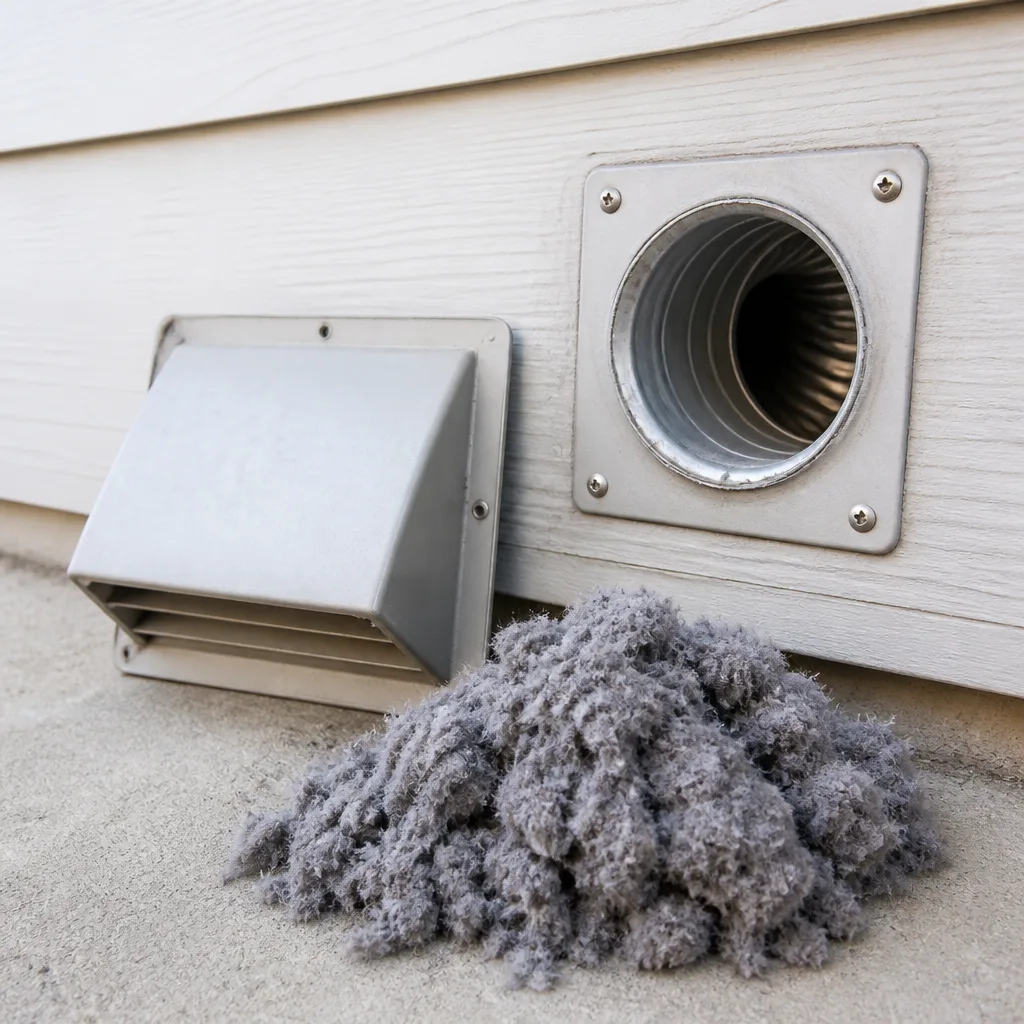 Dryer vent cleaning
 Camera inspection
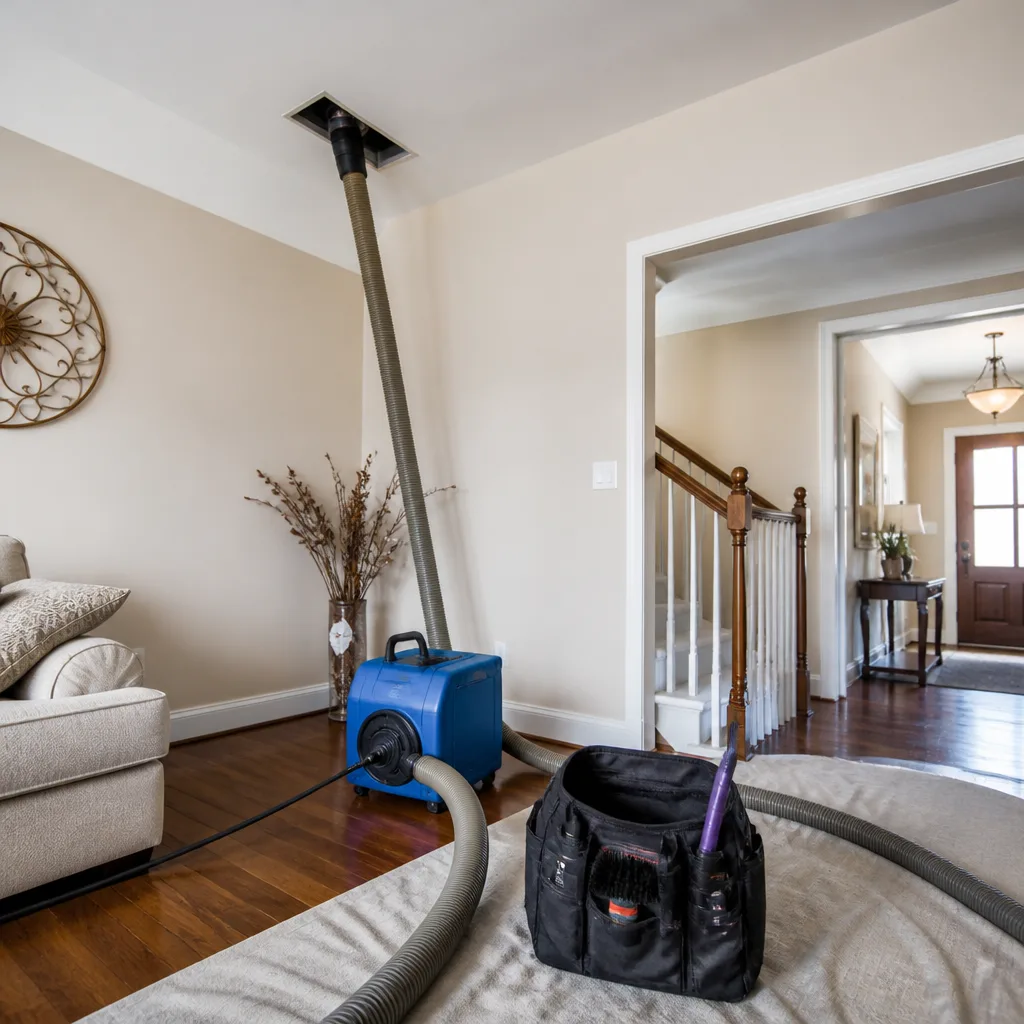 Sanitizing & deodorizing
Whole-system duct and dryer vent check with before-and-after photos - you see exactly what came out of your vents
That "$99 whole-house special" is a bait ad - the real number appears once they are in your hallway, or the "clean" is a shop-vac at the register. We photograph the inside of your ducts before and after instead.
Air Duct Cleaning Cost Breakdown: The Bensonhurst Homeowner’s Reference for 2026
Most Bensonhurst homeowners shop for duct cleaning the way they shop for a tank of gas: find the lowest number and pull in. That instinct works fine for gas. It fails badly for ductwork, because a $89 coupon and a $1,000 invoice can both be honest prices for two jobs that share almost nothing except a name. The coupon often covers two or three vents and a shop vac. The full-system price covers every supply run, the returns, the blower, the coil, and the equipment that keeps dislodged dust from settling back into your living room. This guide breaks the cost down component by component, with realistic 2026 ranges for the Brooklyn market, so you can compare quotes on scope instead of sticker price.
Quick Answer
A legitimate full-system air duct cleaning for a typical single-family home in Bensonhurst runs roughly $450 to $1,000 in 2026, with larger two-family homes and multi-zone systems climbing toward $1,200 or more. Anything under about $200 almost always means vents only, not a full system. The written estimate should itemize what is being cleaned, which equipment is being used, and whether repair or sanitizing is included.
Styles & brands we work with
- Whole-home duct cleaning
- Dryer vent cleaning
- Camera inspection
- Sanitizing & deodorizing
Table of Contents
- Why Duct Cleaning Quotes in Bensonhurst Vary So Widely
- Component-by-Component Cost Breakdown
- What the Equipment Difference Actually Costs You
- Legitimate Add-Ons vs. Upsells With No ROI
- Cost for Two-Family Homes and Multi-Zone Systems
- When the Cheapest Quote Becomes a Liability
- How to Build an Apples-to-Apples Comparison
- How Often Duct Cleaning Really Needs Doing
Why Duct Cleaning Quotes in Bensonhurst Vary So Widely
The spread between the lowest and highest quote in Bensonhurst comes down to three variables: what gets cleaned, what equipment does the cleaning, and what happens after the dust is loose. A quote can be internally honest and still be a fraction of the work. A $89 offer that cleans three supply vents is not lying. It is simply describing a service that does nothing for the return plenum, the air handler, or the coil, which is where most of the dust and biological growth in a Brooklyn system accumulates.
The national benchmark for a true full-system clean in a comparable NYC market sits in the $450 to $1,000 range, and most of the gap between that and a coupon price maps to scope:
- Supplies only vs. full system. Vents-only service leaves returns, blower, and coil untouched.
- Source removal vs. surface dusting. Proper cleaning physically agitates debris off duct walls; a brush on a drill or a shop vac hose mostly stirs it.
- Containment vs. open air. Negative-pressure equipment keeps dislodged material inside the system until it is captured. Without it, you are breathing the job.
- Repair vs. cleaning alone. A gap or disconnected run will re-contaminate a clean system in weeks. Cleaning without checking integrity is half a job.
Price also tracks housing stock. Much of Bensonhurst is older two- and three-story housing where duct runs were retrofitted, added to, or split across floors over decades. That means more joints, more transitions, and more opportunity for a brush to bind or a run to be missed. A crew that prices for a clean, uniform system of runs will underestimate a Bensonhurst retrofit, and a crew that prices honestly has to charge for the time it actually takes.
The single most useful thing you can do before calling anyone is decide what you think your system needs. If you suspect general dust and debris, a full-system clean is the baseline. If you have musty odors, you are likely looking at air duct cleaning plus a look at the coil and drain pan. If your heating bills have crept up without a rate change, the problem may be a leaky run that no amount of cleaning will fix.
Component-by-Component Cost Breakdown
Here is the part most quotes don’t show you: the actual line items. A full-system clean is a set of separate tasks, and they carry different labor, different equipment, and different risk. These are typical 2026 estimates for the Brooklyn market, not exact prices. The written estimate from any company should set the final number for your home.
| Component | Typical 2026 Range (Brooklyn) | What’s Involved |
|---|---|---|
| Supply duct cleaning (per zone or run) | $120 – $350 | Rotary agitation of each supply run, debris extracted under negative pressure. |
| Return plenum cleaning | $150 – $400 | The return side collects far more debris than supplies; larger plenums take longer. |
| Air handler / blower cleaning | $150 – $400 | Blower wheel and cabinet cleaned by hand and with extraction; critical for airflow. |
| Evaporator coil cleaning | $200 – $500 | Coil cleaned in place; heavily soiled coils cost more because they take longer. |
| Drain pan treatment | $75 – $200 | Pan cleaned and treated to stop biological growth at the wet point of the system. |
| Duct repair & sealing | $250 – $900+ | Reconnecting runs, sealing gaps and joints; priced by the number and type of repairs. |
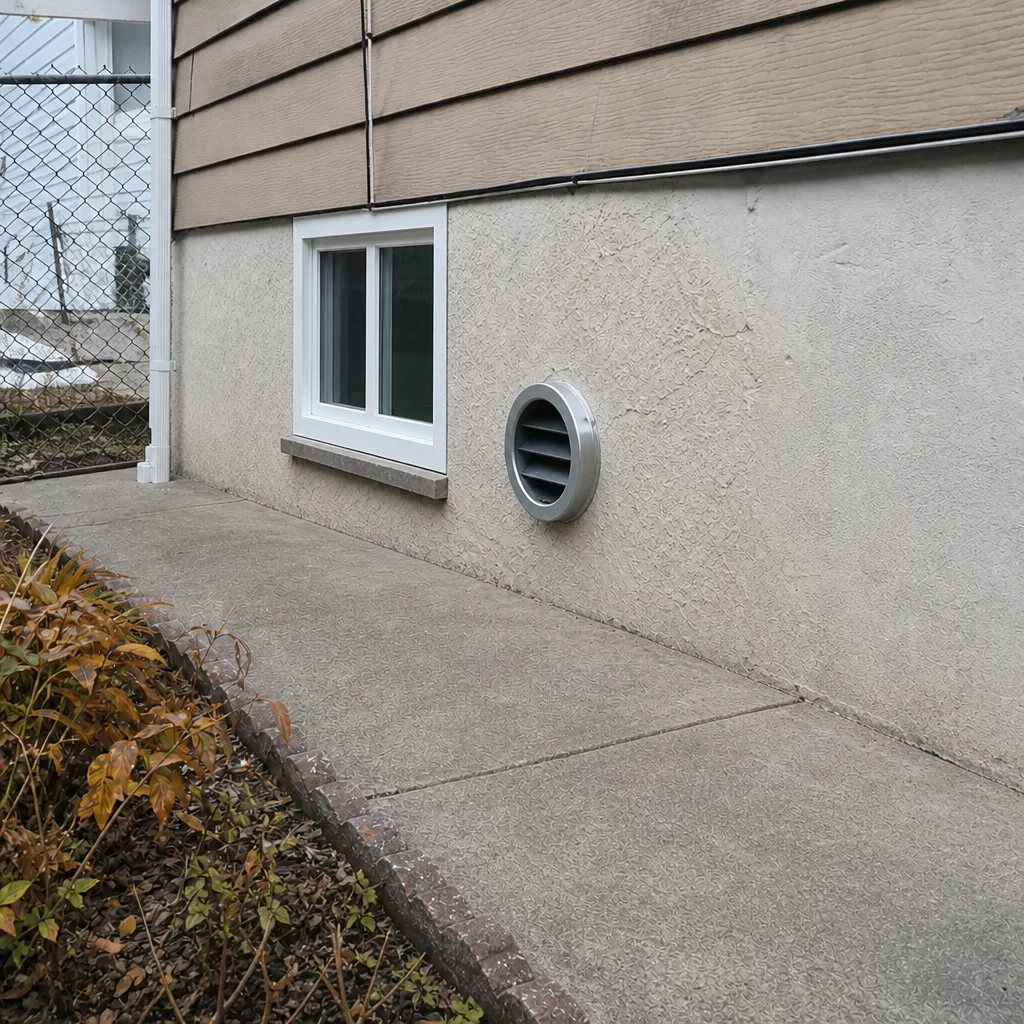
| Dryer vent cleaning | $100 – $250 | Lint and debris removed from the full vent run to the exterior termination. |
| Antimicrobial treatment | $150 – $450 | EPA-registered product applied after cleaning, typically with fogging equipment. |
| UV light installation | $300 – $900 | Fixture installed in the air handler or plenum; priced by size and mounting. |
Add these up for a mid-range single-family home and you land squarely in the $450 to $1,000 band. Add a second system for a two-family and you can double the labor. This is why a $89 quote and a $1,000 quote are not competing for the same customer; they are describing different jobs.
One note on the coil and blower: these are inside the air handler, and working around live electrical components and wet condensate is not a homeowner task. Our technicians have up to 15 years of experience with this equipment, and we’d still tell anyone with an older system to have the power verified off before anyone opens that cabinet. If your coil has never been cleaned, budget for it the first time.
What the Equipment Difference Actually Costs You
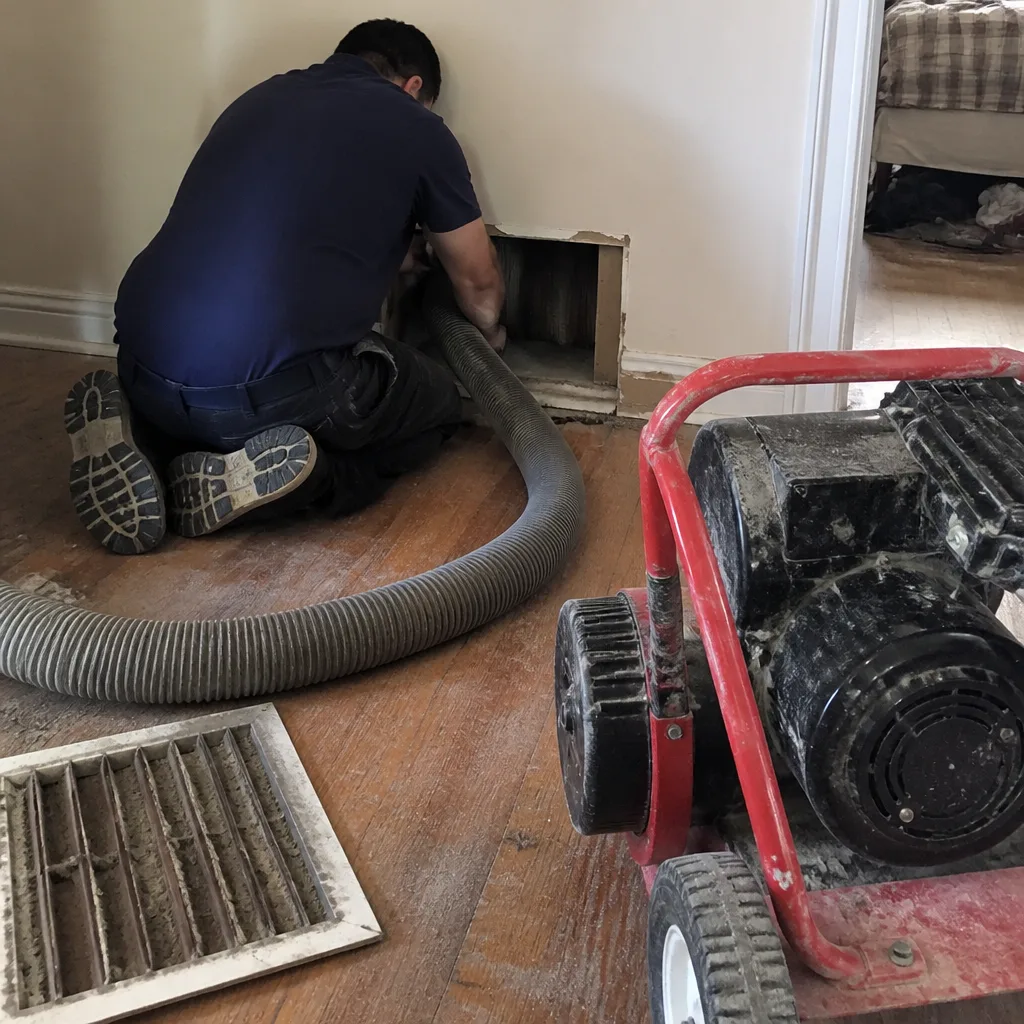
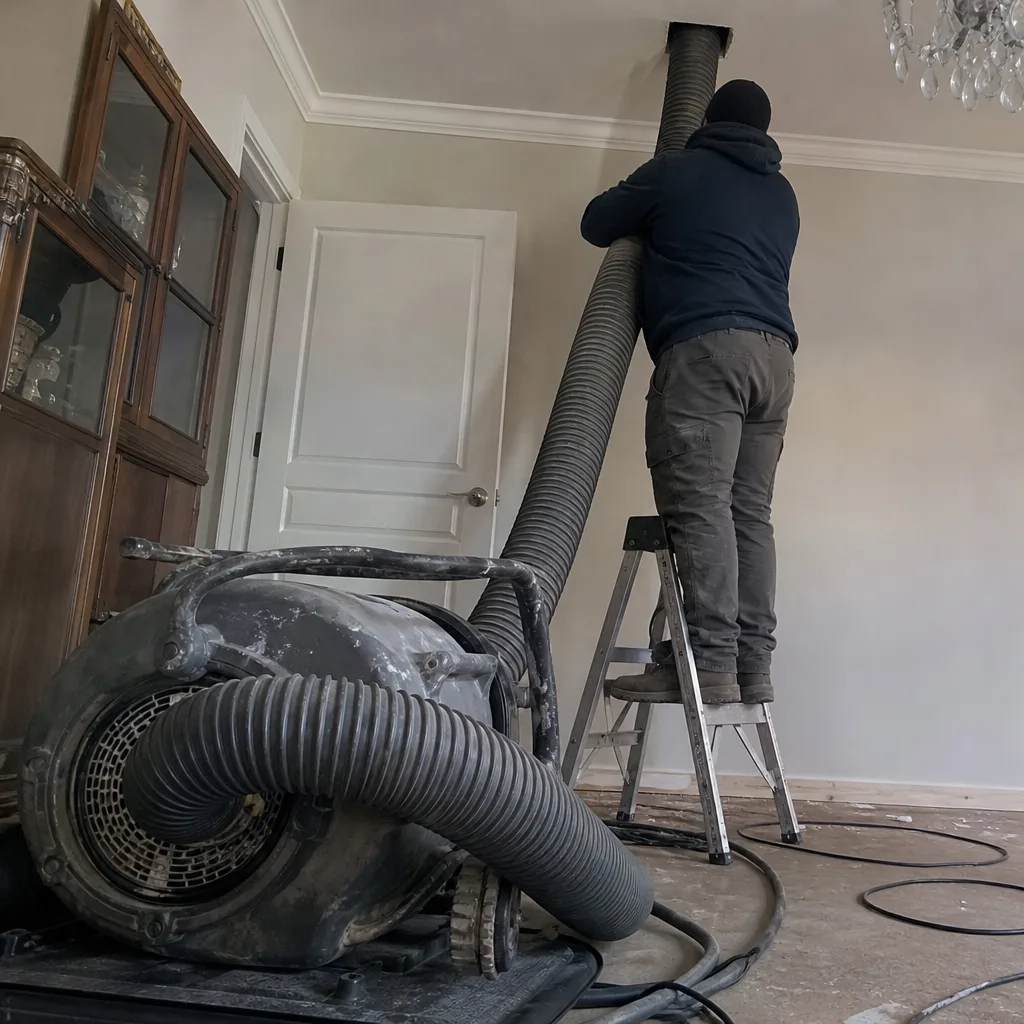
The reason a properly equipped company charges more is not a markup for the badge on the machine. It’s that the machines do a different job. A shop vac pulls at a fraction of the static pressure a purpose-built rig generates, has no way to agitate debris off duct walls, and dumps its exhaust straight into the room you are trying to clean. Three pieces of equipment account for the price gap:
- Rotary agitation (Rotobrush). A rotating brush head physically scours dust and debris off the inside of the duct wall, which is the only way it will move. Vacuum alone leaves the adhered layer in place.
- Negative-pressure containment (Nikro). The system holds the ductwork under vacuum during cleaning so that everything the rotary brush loosens is captured at the source rather than drifting into the room. This is the equipment difference you’ll notice most, because it’s the difference between clean air afterward and a house that smells like a construction site.
- Filtration-grade air handling (Abatement Technologies). These are units built for professional remediation environments, where capturing fine particulate is the entire point. In a residential duct clean, they catch what a standard vacuum would pass back out.
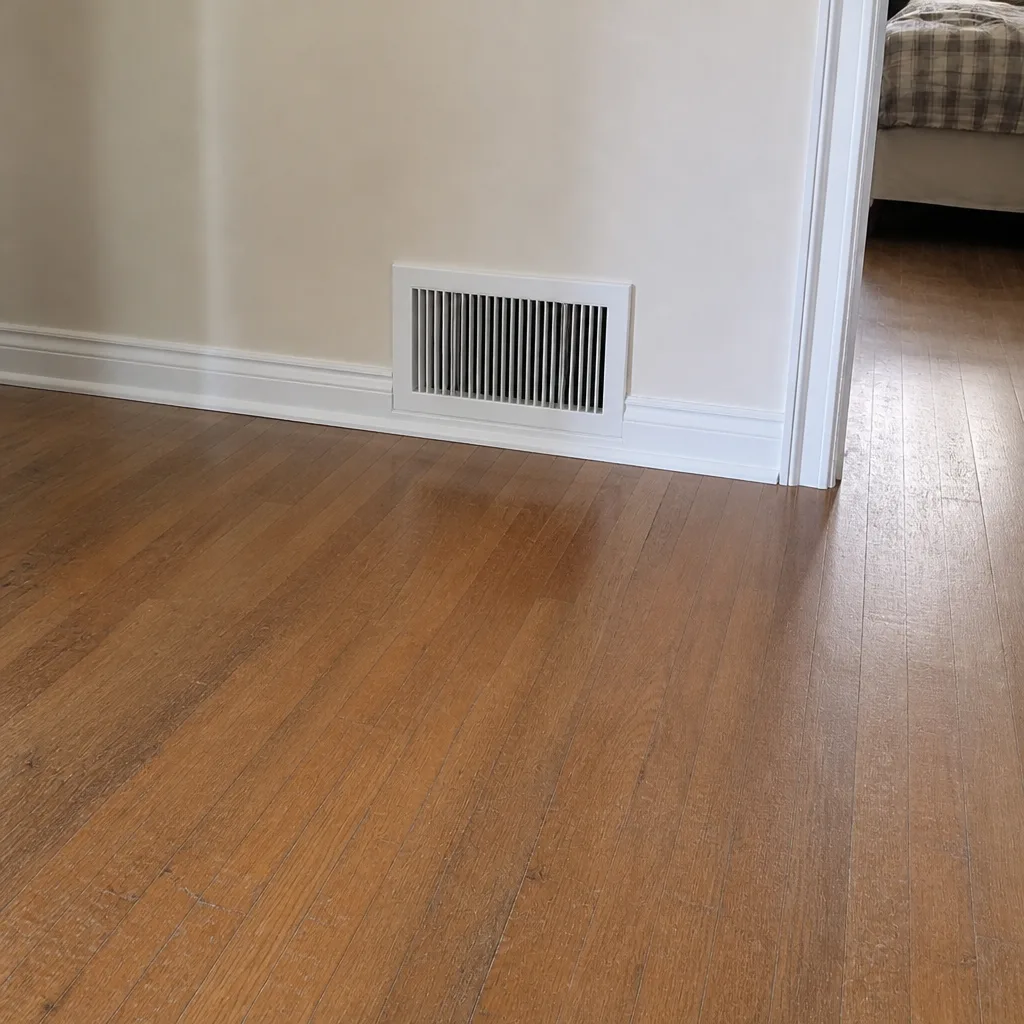
The practical result of the equipment difference shows up in the questions you should ask. A properly equipped crew can show you before-and-after photos of your own ducts. Ask for them. A crew cleaning with a shop vac cannot, because there is no containment port to photograph. Second, ask how they keep debris from spreading through the house during the job. The answer should include negative pressure, not just “we’re careful.” Third, ask whether the equipment is brought in per job or if the quote is based on a truck setup, because the former is what most independent local pros actually run.
We connect homeowners with independent local professionals who use this class of equipment, and we’re specific about it on purpose. The hvac cleaning work that actually protects a system depends on whether the air handler gets the same care as the runs, and the equipment is what makes the difference.
Legitimate Add-Ons vs. Upsells With No ROI
Add-ons are where the honest and the dishonest part ways. Some additions genuinely extend the value of a cleaning. Others are line items designed to lift the invoice. Here’s the split.
Legitimate, defensible additions
- Antimicrobial treatment. If the system has biological growth or persistent musty odor, an EPA-registered treatment applied after cleaning addresses the source. It has real value on a system with an actual problem, and little value on a system that was merely dusty.
- UV light installation. A properly sized fixture in the air handler or plenum (Honeywell and Aprilaire both make products in this category) keeps the wet parts of the system from regrowing growth between cleanings. It is a maintenance investment, not a cure.
- dryer vent cleaning. This one is a fire-prevention service, and it’s frequently left out of duct-only quotes entirely. Lint accumulation in the vent run is a documented cause of residential fires, and it costs a fraction of what a duct clean does.
- Duct repair and sealing. This isn’t really an upsell so much as the second half of a proper job. If a run is disconnected or a joint is open, cleaning it is pointless.
Add-ons you can usually decline
- Fragrance or “fresh air” treatments. These mask odor rather than remove its source, and a cleaned system doesn’t need them.
- Repeated sanitizing on a clean system. One application after a problem clean is defensible; a re-application schedule without a changed condition usually isn’t.
- Whole-house filtration pitched as a duct cleaning upgrade. Filtration is a useful product, but it belongs in an air quality conversation, not bolted onto a cleaning quote.
Our recommendation: accept add-ons that respond to a specific condition you can name (odor, allergy symptoms, a known leak, an old dryer vent), and decline anything the technician can’t tie to a specific finding. You can see our full-service approach on the Air Duct Cleaning Bensonhurst page.
Cost for Two-Family Homes and Multi-Zone Systems
Bensonhurst has a lot of two-family housing, and the cost question changes when there’s more than one system in the building. A two-family home with separate HVAC systems is essentially two cleanings, not one. That means two sets of supplies, two returns, two air handlers, two coils, and two drain pans. If you got a single-system quote for the building, it’s wrong.
Three variables drive cost in a multi-family or multi-zone building:
- Number of systems. Each air handler is its own line item. A dual-system home should be quoted as two jobs.
- Basement or separate lower-level zones. Finished basements are common in Bensonhurst, and a lower-level system serving a basement has its own supply runs and its own return. It adds a full zone.
- Shared ductwork. In some buildings, returns or portions of the trunk are shared between units. Cleaning shared ductwork raises questions about access and scheduling across tenants, and it requires a company that can work around tenants. For property managers, it’s worth confirming in the estimate how shared sections are handled and which units are isolated during the job.
Budget for a two-family home with two full systems in the $900 to $1,800 range depending on the size of each system and how much repair is needed. A single-family home with a finished basement zone often lands in the $600 to $1,200 range. The estimate should break it down per system, so you can see exactly what each one includes.
If you’re a landlord, get the estimate in writing per unit and per system. It protects you if a tenant disputes the scope, and it lets you compare companies on scope rather than on a lump number.
When the Cheapest Quote Becomes a Liability
A low quote is a liability when the work produces a problem the low price didn’t budget for. In our experience, that shows up in a few specific ways in Brooklyn homes.
- Post-cleaning contamination spread. Without negative pressure, the crew loosens dust that then distributes back into living spaces. The system is nominally “cleaned” and the home is dirtier. Addressing it means a second, proper cleaning.
- Missed mold condition. A proper full-system clean includes inspecting the coil and drain pan, which is where growth actually forms. A vents-only job can miss the coil entirely, and the growth continues untouched.
- Damaged components from wrong tooling. A rotary brush applied carelessly can damage flexible duct, insulation lining, or a blower wheel. Repairing that costs more than the cleaning saved.
- Cleaning without sealing. A cleaned system with an open joint or disconnected run re-contaminates in weeks. If the crew doesn’t check integrity, you’ll be re-cleaning sooner than you should.
- Warranty and resale complications. If you sell the home, an improperly cleaned or damaged system is a disclosure item. Buyers ask for records.
We don’t promise same-day service or speed as a selling point for a scheduled job; that’s not what you’re buying. What matters is scope and equipment. The full cleaning service we connect you with is set up so the estimate specifies exactly which of these risks are being addressed.
How to Build an Apples-to-Apples Comparison
To compare quotes on scope, get each company to answer the same set of questions in writing. This is the checklist I’d use in any Bensonhurst home:
- What is cleaned specifically? Ask for each of: supply runs, return plenum, air handler/blower, evaporator coil, drain pan.
- How many supply and return openings does that cover, and is the price per system or per vent?
- What equipment is used for agitation and containment? Ask for make, or at minimum the class of equipment.
- Does the price include a post-cleaning inspection, and will I get before-and-after photos?
- Is duct integrity checked and sealed, or is cleaning priced alone?
- Are antimicrobial treatment, dryer vent cleaning, and UV installation separately itemized so I can see what I’m accepting or declining?
- Is the estimate written and final for that scope, or does the technician have room to change the number on-site?
If a company can’t answer the first three questions, the quote isn’t comparable to anything. One flat price per system, agreed before work starts, with before-and-after photos of your own ducts, is the standard to hold out for.
How Often Duct Cleaning Really Needs Doing
There is no universal schedule. Duct cleaning is driven by conditions, not an annual calendar. Use these guidelines to decide when your Bensonhurst home is due:
- After a renovation or construction. Drywall dust and debris settle into the system and need to come out.
- If you have persistent dust, musty odor, or allergy symptoms that worsen indoors. These are the conditions that point at the duct system.
- After a new home purchase. You don’t know the system’s condition, and a clean is the right starting point.
- If you’ve recently moved into a two-family and one unit is occupied while the other is empty. Cleaning the vacant unit with proper containment protects the tenant.
- On roughly a seasonal check for the dryer vent. Lint accumulation is a fire hazard, and the vent is often the most neglected part of the system.
For a healthy, well-sealed system, cleaning every several years or when conditions change is reasonable. For a system with recent renovation, prior contamination, or a leaky run, cleaning plus repair is the right combination.
Common Mistakes to Avoid
- Comparing a coupon price to a full-system estimate. These aren’t the same job, and the comparison tells you nothing. Ask what’s actually cleaned.
- Accepting a per-vent price. Per-vent pricing rewards a company for adding vents and leaves the returns and air handler out of the picture. One flat price per system is the standard to ask for.
- Skipping the air handler and coil. The coil and blower are where the airflow actually happens, and cleaning them is half the job. Ask specifically whether they’re included.
- Cleaning without checking duct integrity. If the system has a leak or a disconnected run, cleaning it once is paying for a problem to come back. Repair and seal belong in the same visit.
- Declining dryer vent cleaning when the duct crew is already in the building. It’s a separate service, and it’s the one with the fire-prevention case.
- Taking a verbal scope. A written, itemized estimate is the only way to hold a company to what was promised. Get it in writing.
- Not asking for before-and-after photos. If a crew is properly equipped and genuinely thorough, they can show you the before and after. If they can’t, ask why.
See the difference
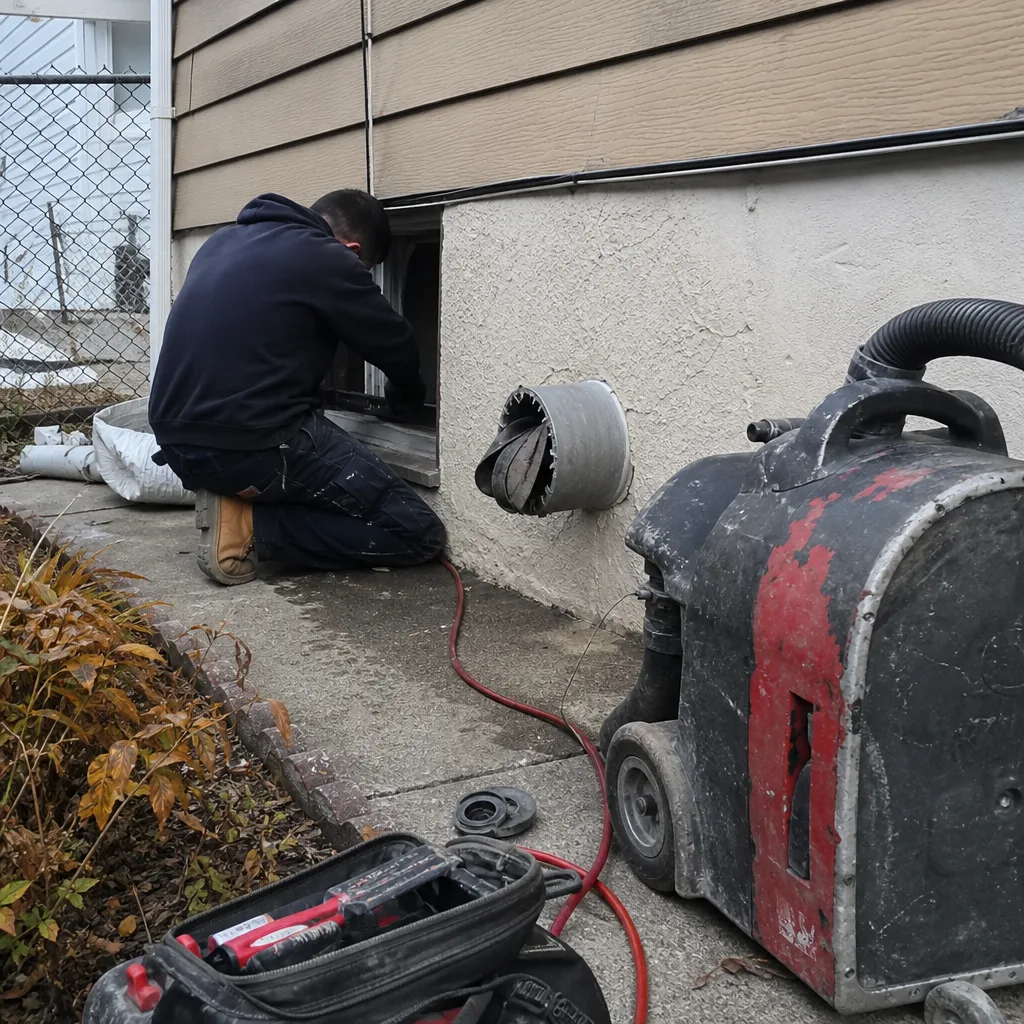 Before
 After
 Before
 After
 Before
 After
When to Call a Professional
Call when you can name a condition: persistent dust on surfaces you’ve just cleaned, a musty smell that follows the heat, allergy symptoms that get worse indoors, a recent renovation, a leaking or disconnected run, or a dryer that’s taking longer to dry a load. Those are the conditions that point at the system, and they’re the ones a proper clean and inspection address. Ductwork, air handlers, and coils carry moving parts, live electrical components, and sharp edges, so this isn’t a homeowner task beyond changing filters. Air Duct Cleaning Bensonhurst offers free estimates in Bensonhurst; call (833) 483-0627. We answer 24/7. Fast dispatch from 7am to 7pm, Sunday through Friday. Our technicians have up to 15 years of experience with commercial-grade equipment, and the written estimate sets the final price.
Frequently Asked Questions
For a typical single-family home in Bensonhurst, a full-system clean runs roughly $450 to $1,000 in 2026, and a two-family home with two systems runs roughly $900 to $1,800. The written estimate should itemize what’s included and set the final price. Call (833) 483-0627 for an exact quote; estimates are free.
Cheaper quotes are almost always smaller jobs: vents only, minimal or no air handler and coil work, and consumer-grade equipment. A $89 offer can be honest for what it covers, but it’s not the same scope as a full-system clean. Ask for the line items in writing before you compare. Call (833) 483-0627 for an exact quote; estimates are free.
Ask for before-and-after photos of your own ducts, and ask for a written scope itemizing each component cleaned. A crew working with Rotobrush and Nikro equipment can show containment and agitation visually, and a proper job ends with a post-cleaning inspection. Call (833) 483-0627 for an exact quote; estimates are free.
Duct cleaning follows conditions, not a calendar. A renovation, persistent dust, musty odor, a new home purchase, or a leaky run are the triggers. For a healthy, sealed system, cleaning every several years is reasonable. Call (833) 483-0627 for an exact quote; estimates are free.
Often close to it, because a two-family with separate systems is two systems to clean: two sets of supplies and returns, two air handlers, two coils. A finished basement with its own zone adds a third. Ask for the estimate per system. Call (833) 483-0627 for an exact quote; estimates are free.
Ask whether the crew uses rotary agitation (Rotobrush is the benchmark), negative-pressure containment (Nikro), and filtration-grade air handling (Abatement Technologies). Those three determine whether debris is captured at the source or redistributed into your home. Call (833) 483-0627 for an exact quote; estimates are free.
The Bottom Line
The $89 coupon and the $1,000 invoice describe two different jobs. If you remember one thing from this guide, make it this: the only number that matters is the scope behind it. Compare quotes on the component list, not the headline. Insist on supply runs, returns, air handler, coil, and drain pan in the estimate, and ask what equipment agitates and captures the debris. Budget $450 to $1,000 for a single-family home, $900 to $1,800 for a two-family, and expect repair and sealing to be part of a proper job. Then check the dryer vent and call it done.
Air Duct Cleaning Bensonhurst connects homeowners and property managers with independent local professionals who use commercial-grade equipment and itemize the work. Call (833) 483-0627 for a free estimate. We answer 24/7. Fast dispatch from 7am to 7pm, Sunday through Friday.
Written by the team at Air Duct Cleaning Bensonhurst.